Hartford Lawn Fertilization Schedule: A Season-by-Season Breakdown
A 4-5 application fertilization program built for Zone 6b cool-season turf. Pre-emergent timing, summer feed limits, fall root building, and winterizer details.
Healthy turf starts with the right nutrients at the right time. Guessing on fertilizer dates is the single biggest mistake property owners make with their lawns, and it leads to wasted product, thin grass, and weed invasions that could have been prevented.
Our team at Landscaping Hartford builds every fertilization plan around actual soil temperatures rather than fixed calendar dates. Zone 6b clay soils behave differently than sandy coastal soils, and the timing matters down to the week.
Here is the program we follow for properties across Hartford County.
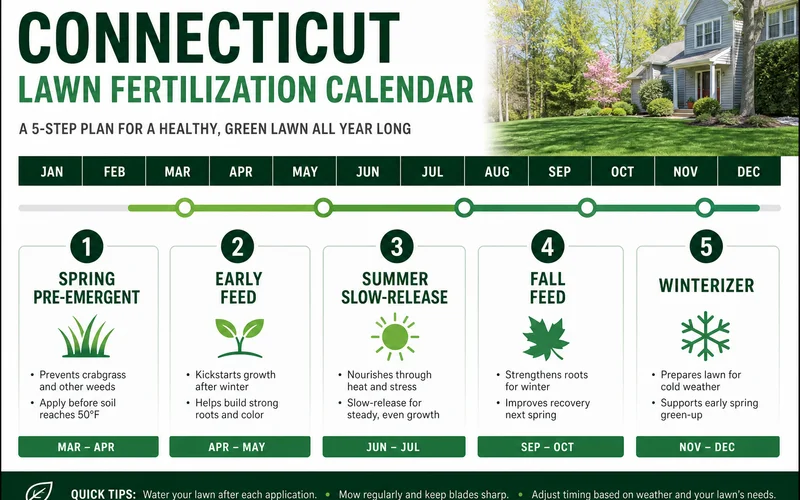
Pre-Emergent and Early Feed: Late March Through Mid-April
Soil temperature is the trigger. Once the top two inches reach 55 degrees Fahrenheit, crabgrass seeds start germinating. Forsythia bushes blooming across the neighborhood serve as a reliable visual marker for this exact temperature threshold.
We apply a granular pre-emergent containing prodiamine to create a chemical barrier in the soil. This barrier blocks annual grassy weeds for three to four months when applied correctly. Too early and spring rains wash the barrier out before it does its job. Too late and the crabgrass has already sprouted past the point of prevention.
The early feed portion provides a balanced nitrogen boost to wake up dormant roots. We pair this with a soil sample sent to the UConn Soil Nutrient Analysis Laboratory in Storrs, which runs about $16 per test and reveals exact pH levels and nutrient gaps specific to your property.
| Active Ingredient | Application Window | Primary Advantage |
|---|---|---|
| Prodiamine (Barricade) | Late March | Longest residual weed control |
| Dithiopyr (Dimension) | Early to Mid-April | Controls young crabgrass post-emergence |
Late Spring Nitrogen: Mid-May to Early June
The second application uses slow-release nitrogen to sustain the spring growth flush without burning the turf. Quick-release formulas push excessive top growth and leave roots exhausted heading into summer heat.
We keep mower blades at 3.5 to 4 inches during this phase. Taller grass naturally shades the soil surface, which suppresses germinating broadleaf weeds like dandelion and clover.
Persistent broadleaf weeds that escaped the pre-emergent barrier get spot-sprayed rather than blanket-treated. Targeted applications reduce chemical use while eliminating the problem plants directly.
Keeping mower blades sharp through late spring prevents moisture loss from ragged cuts. A clean slice heals faster and helps the plant handle the transition into hot weather.
For grassy weeds that emerge despite the pre-emergent, a post-emergent product containing quinclorac applied at the two-to-four-leaf stage provides effective control. Adding a surfactant to the spray ensures the product sticks to the leaf surface.
Controlled Summer Feed: Late June to Early July
Cool-season grasses naturally shed roots during peak summer heat as a survival mechanism. Pushing growth during July and August with fast nitrogen forces the plant to burn energy reserves it needs to survive.
We use a controlled-release formula that delivers nutrients slowly over six to eight weeks. Many lawns with adequate organic matter and light irrigation can skip this application entirely without visible decline.
Hydration matters far more than fertilizer during a heatwave. The target is 1 to 1.5 inches of water per week, applied in the early morning to prevent fungal issues. Overwatering encourages shallow root systems and creates the humid conditions that foster brown patch and dollar spot.
Fall Root Builder With Lime: Early to Mid-September
This is the most impactful feeding of the entire year. The September application drives deep root development that stores energy for winter dormancy and produces a dramatically thicker spring green-up.
Hartford County clay soils run acidic, typically falling between pH 5.8 and 6.2. Lime corrects this imbalance and pushes the pH toward the 6.5 to 7.0 range where cool-season turf absorbs nutrients most efficiently. We incorporate core aeration and overseeding during this same visit because warm soil and cool air temperatures create ideal germination conditions.
Phosphorus Regulations in Connecticut
State law restricts phosphorus application on established lawns to protect waterways from toxic algal blooms. Our maintenance fertilizers use a zero-phosphorus formula, such as a 5-0-10 blend. Starter fertilizer containing phosphorus is only permitted when actively seeding bare soil. This regulation applies across the state and is enforced through CT DEEP oversight.
Winterizer Application: Late October to Early November
The final round uses a high-potassium formula designed to harden the plant off before the first hard freeze. Potassium strengthens cell walls and functions like antifreeze for the grass crown, reducing the risk of winter kill and snow mold.
We completely avoid high-nitrogen products during late fall. New growth triggered by nitrogen gets destroyed by the first frost, leaving the plant vulnerable all winter.
Key benefits of this final application:
- Protects the grass crown from deep freezes reaching 16 degrees in January.
- Strengthens the turf against foot traffic and snow load.
- Reduces the likelihood of gray snow mold appearing in March.
Heavy leaf cover left on the lawn traps moisture and blocks the winterizer from reaching the soil. Our crews coordinate the final application with a thorough leaf removal pass to ensure the product contacts the turf directly.
Building Your Annual Plan
The full program runs four to five applications timed to actual weather conditions rather than rigid calendar dates. We coordinate fertilization visits with your recurring mowing schedule to ensure proper nutrient absorption between cuts.
You can choose organic, synthetic, or hybrid product lines based on your priorities and budget. David Miller and the Landscaping Hartford crew designed this fertilization and weed control program specifically for the challenges of Zone 6b turf and the acidic clay soils found throughout the Connecticut River Valley.
Start by scheduling your soil test in early March. From there, the entire year unfolds in a logical sequence built around what the soil actually needs.
Related Service
Learn more about Lawn Fertilization & Weed Control in Hartford
Ready to book? Get a free written estimate for lawn fertilization & weed control in hartford from our Hartford County team.
Visit the Lawn Fertilization & Weed Control in Hartford Page