How Often Should You Mow Your Lawn in Connecticut?
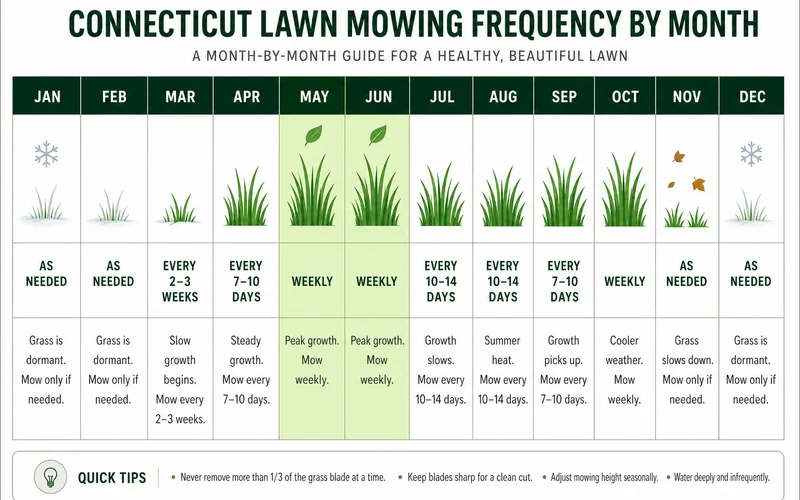
Connecticut mowing frequency by season: weekly during the May-June peak, bi-weekly when heat slows growth, and weekly again for the fall flush. Zone 6b height guidance.
The mowing schedule that works in May does not work in July. Cool-season grasses in Connecticut follow a predictable growth pattern driven by soil temperature and rainfall, and matching your cutting frequency to that pattern is what separates a healthy lawn from one that looks stressed all season.
Zone 6b gives Hartford County a frost-free growing season of about 233 days. Within that window, growth accelerates, slows down, and surges again in a rhythm that directly dictates when the mower should be running.
Growth Phases That Drive the Schedule
The dominant local species, including Kentucky Bluegrass, Perennial Ryegrass, and Turf-Type Tall Fescue, move through three distinct growth phases each year.
- Spring flush (May to June): Heavy, aggressive growth. Healthy turf can add 1 to 1.5 inches per week.
- Summer slowdown (July to August): High heat pushes the grass into partial dormancy. Vertical growth drops significantly.
- Fall recovery (September to October): Cooler nights trigger a second growth surge, though less intense than spring.
University of Connecticut Extension research confirms that grass breaks dormancy when soil temperatures reach 50 to 55 degrees, which typically happens by mid-April in the region.
Why the One-Third Rule Controls Everything
Never remove more than one-third of the total blade height in a single session. This guideline, established by turf scientists and reinforced by every credible university extension program, prevents the plant from burning stored root energy to recover from an aggressive cut.
During peak spring growth, even a seven-day gap pushes many lawns close to the one-third limit. A two-week gap during May virtually guarantees a violation that stresses the root system and opens the door to weed invasion.
Correct Height by Grass Species
Height matters just as much as frequency. Maintaining the right mowing height prevents scalping, conserves soil moisture, and naturally suppresses weed germination.
| Grass Species | Spring/Fall Height | Summer Height |
|---|---|---|
| Kentucky Bluegrass | 2.5 to 3.5 inches | 3.0 to 4.0 inches |
| Turf-Type Tall Fescue | 3.0 to 4.0 inches | 3.5 to 4.5 inches |
| Perennial Ryegrass | 2.0 to 3.0 inches | 2.5 to 3.5 inches |
Raising the deck by half an inch in July provides immediate benefits. Taller blades cast larger shadows across the soil surface, which drops ground temperature by several degrees and conserves moisture during dry stretches.
Summer Scalping and Its Consequences
Cutting too short during hot weather exposes the topsoil to direct sunlight. This triggers dormant weed seeds, particularly crabgrass, to germinate and fill the gaps left by stressed turf. Maintaining a taller profile acts as a natural pre-emergent barrier.
The high humidity common in the Connecticut River Valley makes disease prevention critical during summer months. Scalped lawns are far more vulnerable to brown patch fungus and dollar spot than lawns maintained at the correct height.
When Bi-Weekly Actually Works
Mid-July through August is the window where stretching to a 14-day interval makes practical sense. High temperatures and reduced rainfall cause cool-season grass to naturally slow its vertical growth.
Forcing weekly cuts during this dormancy period wastes money and can damage drought-stressed turf. The mower tires compact dry soil, and the blades cut into brittle crowns that are already struggling.
Cutting stressed grass during a drought burns the lawn faster than skipping a week. Let the biology guide the schedule, not the calendar.
Recent 2026 local surveys indicate average weekly mowing service in Connecticut ranges from $30 to $85 per visit. Skipping unnecessary July and August cuts saves real money without sacrificing curb appeal. Compare the full cost breakdown in our weekly vs bi-weekly mowing guide.
The Fall Return to Weekly
By early September, cooler nights trigger the second major growth surge of the year. Weekly mowing returns and stays through October to manage both the accelerating grass growth and the falling leaves.
Fall mowing serves dual purposes:
- Mulching leaves directly into the turf canopy, where they break down and return nutrients to the soil.
- Maintaining height to suppress winter annual weeds before dormancy.
- Preventing snow mold by keeping the grass at a manageable length entering winter.
- Processing leaf drop through multiple passes that no single cleanup can replicate.
The final cut of the season drops the deck slightly to prevent the grass from folding over and trapping moisture under snow. This step is the last defense against the fungal diseases that develop over winter.
Building a Schedule That Adapts
The best mowing program is one that flexes with the weather rather than following a rigid calendar. A weekly lawn maintenance plan that adjusts frequency based on growth conditions produces better results than any fixed schedule.
Our crews maintain hundreds of Hartford County properties using this adaptive approach, and the same team handles your property every visit. Reach out for a fixed-price estimate that accounts for your specific lot size, turf type, and seasonal needs.
Related Service
Learn more about Lawn Mowing & Maintenance in Hartford
Ready to book? Get a free written estimate for lawn mowing & maintenance in hartford from our Hartford County team.
Visit the Lawn Mowing & Maintenance in Hartford Page