Weekly or Bi-Weekly Mowing: Which Schedule Fits Your Property?
A direct comparison of weekly versus bi-weekly lawn mowing. When each works in Connecticut, how costs differ, and what the turf science actually says.
Every spring, the same question comes up: should you pay for weekly service or stretch it to every two weeks? The answer depends entirely on the calendar and how fast your grass is growing at that specific moment.
Cool-season grasses in Zone 6b follow predictable growth patterns. During the explosive spring flush, seven-day intervals are barely enough. During summer heat, fourteen-day gaps work fine. The trick is matching your schedule to the biology rather than picking one frequency for the entire season.
The One Rule That Decides Everything
The University of Connecticut Extension program established the guideline that matters most: never remove more than one-third of the grass blade in a single cut. Violating this rule forces the plant to burn stored root energy for recovery, which weakens the entire root system over time.
Removing more than one-third of the leaf surface at a single cutting shocks the plant and leads to thinning, yellowing, and increased weed pressure.
During peak spring growth, a healthy lawn can add 1 to 1.5 inches per week. At that rate, a two-week gap means cutting through 2 to 3 inches of growth, which easily violates the one-third threshold for a lawn maintained at 3.5 inches. For detailed monthly breakdowns, see our guide on mowing frequency in Connecticut.
Conditions That Favor Weekly Service
Weekly mowing is the clear winner during the aggressive spring growth period and on properties where appearance standards matter.
From mid-April through late June, cool-season turfs like Kentucky Bluegrass grow rapidly across Hartford County. Skipping a week during this surge forces the mower to work through heavy, wet clippings that clump on the surface and smother the grass underneath.
Shade adds another layer. Many neighborhoods feature mature oak and maple canopies. Grass growing under heavy shade already struggles to gather light, and removing too much leaf surface in one cut drastically limits its ability to photosynthesize.
Weekly service is practically required in these situations:
- Peak spring growth from mid-April through late June when blade growth is fastest.
- Irrigated properties where consistent watering pushes continuous, uninterrupted growth.
- High-visibility yards subject to HOA standards or front-facing curb appeal expectations.
- Large lots where a missed week produces a massive volume of clippings that smother the turf.
When Bi-Weekly Makes Sense
The mid-summer slowdown from mid-July through August is where bi-weekly service genuinely works. High heat pushes cool-season grass into partial dormancy, and growth drops dramatically.
Mowing drought-stressed turf too frequently causes unnecessary damage. Raising the mower deck to 3.5 inches during these months helps the grass shade its own root zone and conserve moisture.
Bi-weekly fits well under these conditions:
- Sustained heat waves above 85 degrees where growth practically stops.
- Drought periods when infrequent cutting prevents tire damage to brittle grass crowns.
- Low-traffic areas like backyards that can handle a slightly less manicured look.
- Budget-conscious properties where owners accept occasional overgrowth to reduce total seasonal cost.
The Real Cost Difference
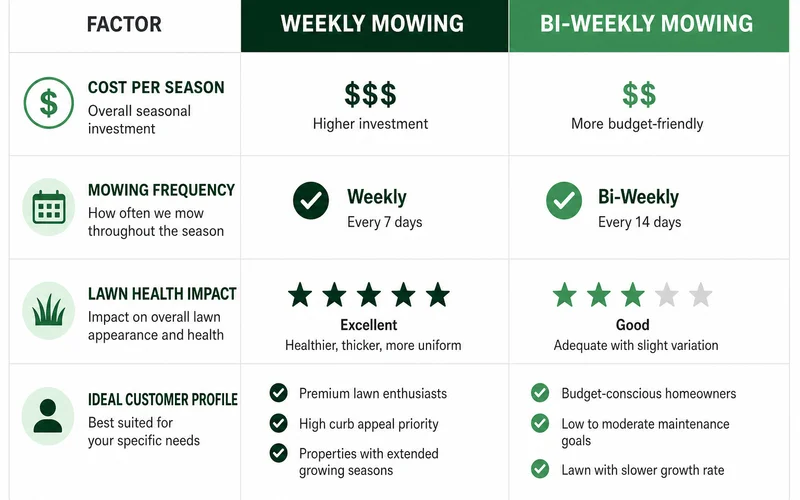
Weekly service costs less per individual visit than bi-weekly because the crew moves faster through well-maintained turf. But the total monthly bill is higher because you are paying for four visits instead of two.
Bi-weekly visits take longer per stop. The crew must make slower passes through taller grass, manage heavier clipping volumes, and spend extra time trimming overgrown edges. That additional labor typically adds a 15 to 25 percent surcharge per visit compared to a weekly rate.
Based on 2026 pricing in the Hartford County area, a standard quarter-acre lot runs approximately $60 to $100 per visit.
| Schedule | Average Cost Per Visit | Visits Per Month | Monthly Total |
|---|---|---|---|
| Weekly | $60 | 4 | $240 |
| Bi-Weekly | $72 | 2 | $144 |
A weekly contract runs roughly 1.8 to 1.9 times the monthly cost of bi-weekly for the same property. The per-visit savings come from route predictability, which keeps the crew’s base rate lower.
The Flexible Seasonal Contract
The most effective approach for properties in Hartford County is a contract that adjusts through the year. Start with weekly visits in the spring, shift to bi-weekly during summer dormancy, and return to weekly for the fall growth flush and leaf management.
This hybrid schedule aligns with the natural biological cycle of cool-season grasses. The property gets intensive attention when growth demands it and conserves visits when the turf naturally slows down.
A dynamic schedule requires a provider willing to flex mid-season without new paperwork or renegotiation. The Landscaping Hartford team structures all recurring mowing contracts to accommodate these transitions seamlessly. Reach out for a customized estimate that matches your specific property and budget.
Related Service
Learn more about Lawn Mowing & Maintenance in Hartford
Ready to book? Get a free written estimate for lawn mowing & maintenance in hartford from our Hartford County team.
Visit the Lawn Mowing & Maintenance in Hartford Page